

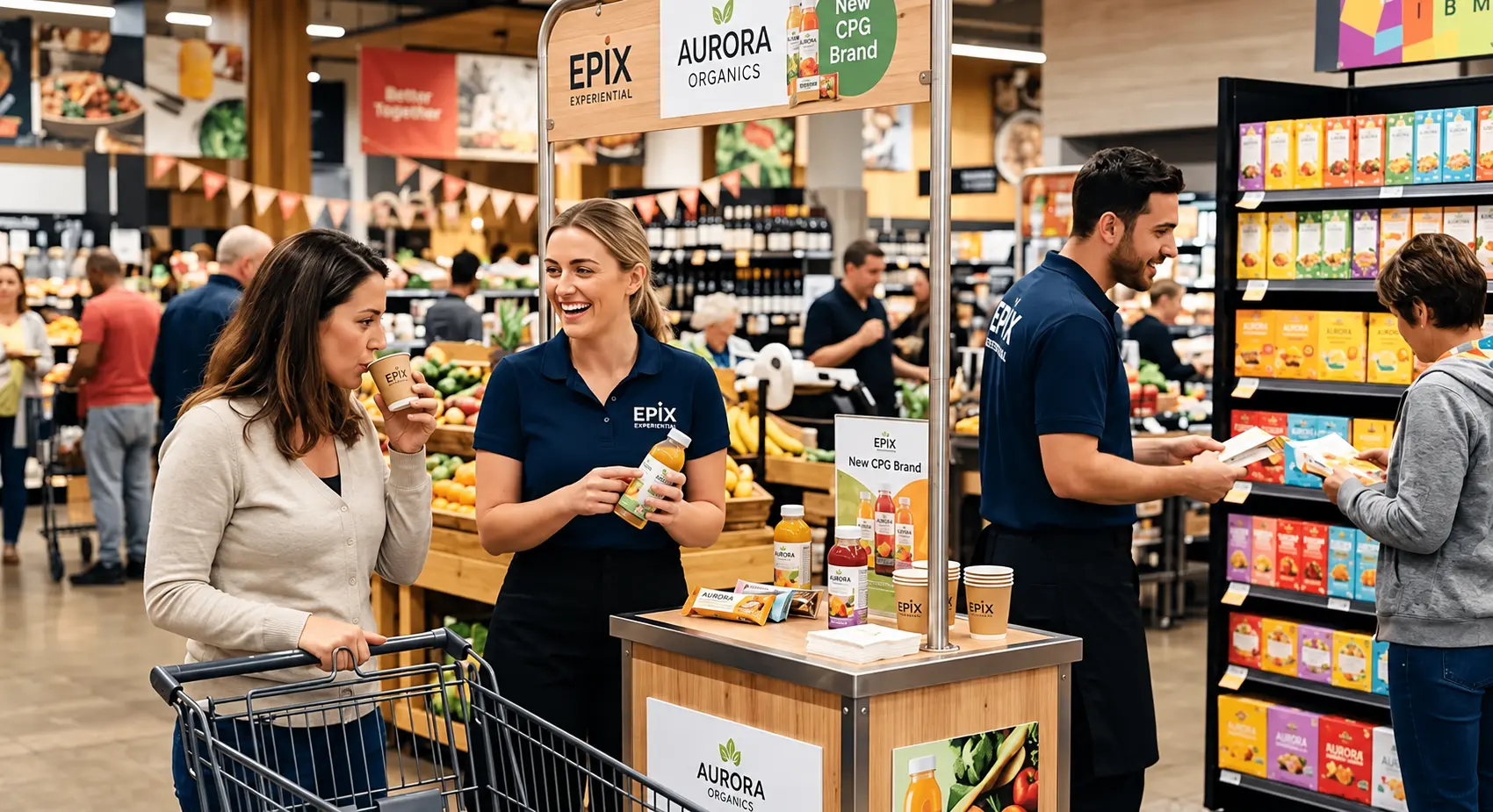
A good in-store sampling program starts with one clear goal and the store’s approval. Then you choose the right stores and hours, keep food at the right temperatures, and staff each table with people who know the product. Finally, you track what sold. This guide walks through each step, including the rules that apply to food and alcohol samples in Georgia.
What an in-store sampling program includes
An in-store sampling program is a planned run of product tastings or demos inside retail stores. Shoppers try the product near the shelf, ask questions and can buy it on the spot. A program is more than one demo day. It covers which stores, how often, who staffs the table, what the kit holds and how you judge the results.
The planning steps for an in-store sampling program are the same whether you sample crackers, cold brew or a new sauce. Food and drink add extra rules, which are covered in steps 4 and 5.
Step 1: Set one goal and a number to measure
Pick the one result that matters most. Most brands choose one of these:
- Trial: get the product into as many mouths as possible.
- Sales lift: sell more units during and after the demo.
- Sign-ups: collect emails or texts for later offers.
Then write down the number you will measure and where it comes from. For sales lift, you need the store’s normal sales of your product before the demo. Without that baseline, you cannot tell whether the demo changed anything.
Step 2: Get the retailer on board
No in-store sampling program happens without the store’s approval. Some chains run their own demo programs with set days and vendors. Others leave it to each store manager. Ask early, and get the answers in writing.
Questions to ask the retailer:
- Which days and hours are open for demos?
- Where can the table go, and is there a power outlet nearby?
- Do you need proof of insurance from us or our staffing provider?
- What are your rules for food handling, gloves and hair covers?
- Will you share sales data for the demo days?
- Will you order extra stock before the demo?
Don’t skip that last one. A busy demo next to an empty shelf wastes the whole day.
Step 3: Choose stores, days and times
Pick stores where your target shoppers already buy, and where the product is on the shelf. Then pick the busiest hours. For many grocery stores that means weekend middays and weekday evenings, but each store is different. Ask the manager when traffic peaks.
Set the table close to where your product sits on the shelf. A shopper who likes the sample should be able to pick it up in a few steps, not hunt for it across the store.
Start small. Run a few stores first, check the results, then add more.
Step 4: Plan food safety and allergens
In Georgia, grocery stores are food sales establishments. They must hold a license from the Georgia Department of Agriculture [1]. That license belongs to the store. Ask the store whether your demo is covered by its license, and what it needs from you before day one.
Temperature is the rule that trips up most demos. Georgia’s retail food guidelines set a maximum of 41°F for cold foods and a minimum of 135°F for hot foods [1]. In practice, that means:
- Keep cold samples in a cooler with a thermometer, and check it through the day.
- Keep hot samples in a heated holder, not in a pan that slowly cools.
- Only put out a small amount at a time.
Allergens are the second big risk. U.S. law names 9 major food allergens [2]. They are peanuts, tree nuts such as almonds or walnuts, milk, eggs, wheat, soy, fish, shellfish such as shrimp or crab, and sesame [2]. Sesame was added as the ninth, effective January 1, 2023 [2].
Put a clear sign at the table that lists any of these in your product. Train staff to answer “Does this have nuts?” with the label in hand, not from memory. Use separate utensils for each product so samples do not mix.
Step 5: Alcohol tastings in Georgia follow their own rules
Wine, beer and spirits brands face stricter limits. Georgia’s Department of Revenue explains the rules for tastings at retail package stores (liquor stores) [3]:
| Rule | What it says |
|---|---|
| How often | Up to 52 tasting events per calendar year, and one per day [3] |
| How long | No more than 4 hours per event [3] |
| What type | Only one type per event: beer, wine, or spirits [3] |
| How much per person | Beer 8 ounces, wine 5 ounces, spirits 1.5 ounces [3] |
| Open bottles | No more than 4 bottles or cans open at one time [3] |
| Who can attend | Only adults 21 or older can be served [3] |
One rule catches many brands off guard. Representatives of a manufacturer or wholesaler may attend the tasting, but they may not host the event or pour any drinks [3]. They also may not give shoppers, the store or its staff anything of value [3]. So leave the coupons and free gifts at home for these tastings.
The store runs and pours the tasting. The store must also notify its city or county before the event [3].
These rules cover package stores. Grocery stores and other places may work differently, so check with the store and your local government first.
Step 6: Build the kit and staff each table
Pack everything once so nobody runs back to the car. Use the same kit list for every store in your in-store sampling program. Here is a simple checklist:
| Item | Why it matters |
|---|---|
| Table and a clean table cover | Shoppers trust a tidy station |
| Cooler or heated holder, plus a thermometer | Keeps samples at the right temperature |
| Sample cups, napkins and toothpicks | Small, single portions |
| Gloves and hand sanitizer | Clean hands for every batch |
| Allergen sign | Answers the first question many shoppers ask |
| Trash bag with a lid | Keeps the area clean |
| Coupons or QR code cards | Gives shoppers a reason to buy today |
| Tally sheet or counter | Tracks samples given and questions asked |
Staffing matters just as much as the kit. The person at the table needs a short talk track (a simple script): what the product is, why it is different, and what it costs. They should also know where it sits on the shelf. Keep the talk track to three or four points. A long speech loses shoppers who are just passing by.
Plan for breaks and backups too. One person working a long demo alone will have gaps when they step away. Our guide to sizing a team for events covers shifts and breaks in more detail.
Step 7: Track results and report
Measure the same things at every store in your in-store sampling program, so you can compare them. A simple report covers:
- Samples given out
- Units of your product sold on the demo day
- Units sold in the same store on a normal day (your baseline)
- Coupons used or QR codes scanned
- The questions shoppers asked most
- Any problems: low stock, no power, a bad table spot
Look at sales again a few weeks later. A good demo can bring repeat buyers, not just one-day sales. If your in-store sampling program runs in many stores, compare demo stores with similar stores that had no demo.
When sampling is not the right fit
Sampling works well when tasting or trying the product changes a shopper’s mind. It fits less well in a few cases:
- The product is already well known. Shoppers who know the taste may not stop.
- The product needs a long explanation. A busy aisle gives you seconds, not minutes.
- The store cannot stock enough. If shelves run empty, the demo cannot pay off.
- You make very little on each sale. Product, staff and travel costs add up for every store day.
How Epix can help with your in-store sampling program
Epix Experiential runs product demonstrations and sampling for brands. Our page for CPG brands explains how we support consumer product brands with sampling staff. For food and drink, our food and alcohol brand staffing includes licensed bartenders and certified food handlers. We also rent coolers for events, listed on our event products page.
To plan a program, contact the Epix team.
Frequently asked questions
Does my brand need its own license to sample in a Georgia grocery store?
In Georgia, the grocery store holds the food sales license from the Department of Agriculture [1]. Ask the store whether your demo is covered by its license and what it needs from you. If you are unsure, contact the department’s Retail Food Program.
Can our brand rep pour wine at a Georgia liquor store tasting?
No. Under the Department of Revenue’s guidance, manufacturer and wholesaler reps may attend but may not host the event or pour [3]. The store pours.
How long should a demo day be?
Long enough to cover the store’s busiest hours, with breaks planned. Alcohol tastings at Georgia package stores cannot run longer than 4 hours [3]. For food demos, ask the store when traffic peaks and build the shift around it.
What should staff do if a shopper asks about allergens?
Show them the label or the allergen sign. Never guess. If staff are not sure, they should say so and not offer the sample.
Sources
- Georgia Department of Agriculture: Basic Requirements for Retail Food: food sales establishment license, cold and hot food temperatures
- U.S. Food and Drug Administration: Food Allergies: the 9 major food allergens, sesame added in 2023
- Georgia Department of Revenue: Alcoholic Beverages Tasting Events for Retail Package Store Customers: package store tasting rules